
- What Makes a Sofa “Japandi”?
- Key Features of a Japandi Sofa
- The Materials That Matter
- The Japandi Color Palette for Sofas
- Styling Your Japandi Sofa
- Our Top Japandi Sofa Picks
- Frequently Asked Questions
- Final Thoughts
There is a particular kind of comfort that exists in stillness. Not the loud, overstuffed comfort of traditional recliners, nor the cold precision of ultra-modern design — but something quieter, more intentional. A comfort found in low profiles, natural textures, and the generous use of negative space. This is the comfort of a Japandi sofa, and it is transforming how we think about the centerpiece of our living rooms.
Japandi — the beautiful marriage of Japanese wabi-sabi philosophy and Scandinavian hygge warmth — has emerged as one of the most enduring interior design movements of the decade. At its heart lies a reverence for simplicity, natural materials, and the idea that the objects we live with should bring us peace. Your sofa, the largest and most used piece of furniture in your home, becomes the perfect canvas for expressing this philosophy.
In this guide, we will explore exactly what makes a sofa “Japandi,” which materials and colors define the aesthetic, how to style your space around your seating, and our carefully curated selection of the best Japandi-inspired sofas available today. Whether you are furnishing your first apartment or refining a long-loved living space, this guide will help you find a piece that feels like a deep breath.
What Makes a Sofa “Japandi”?
The term “Japandi” may be relatively new to the design lexicon, but the principles behind it are centuries old. Japanese design brings wabi-sabi — the acceptance of imperfection and transience — along with ma, the concept of negative space as an active design element. Scandinavian design contributes hygge, the Danish art of cozy contentment, and a democratic approach to functional beauty. When these two worlds meet in a sofa, something magical happens.
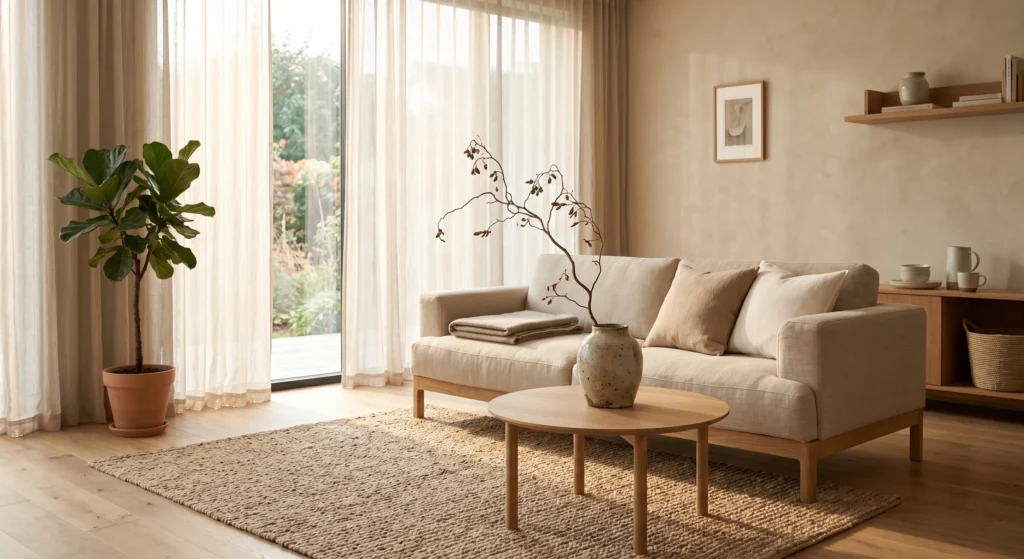
A Japandi sofa is never trying too hard. It does not shout for attention with bold colors or ornate detailing. Instead, it earns its place in a room through proportion, material honesty, and an almost meditative calm. The frame is typically low to the ground, grounding the space and creating visual openness above. The lines are clean but not harsh — there is a softness to the geometry, a rounded corner here, a gentle slope there, that keeps the piece from feeling clinical.
Importantly, a Japandi sofa respects the Japanese principle of danshari — the practice of decluttering and choosing only what is necessary. This means no excessive throw pillows built into the design, no reclining mechanisms that complicate the silhouette, no cup holders or USB ports disrupting the clean lines. The sofa exists to provide comfort and beauty in their most essential forms.
Key Features of a Japandi Sofa
Low Profile, Grounded Presence
Japandi sofas typically sit lower to the floor than traditional Western designs — often with seat heights between 15 and 17 inches. This low-slung silhouette creates an immediate sense of spaciousness in a room by opening up the vertical plane. It also changes how we inhabit the space; sitting closer to the ground has a subtle psychological effect of grounding and centering us. Many designs feature exposed wooden legs in warm oak or walnut, raising the body just enough to create lightness while maintaining that essential connection to the earth.
Clean Lines With Soft Geometry
While Japanese design leans toward rectilinear precision and Scandinavian design favors organic curves, Japandi sofas find the sweet spot between the two. You will see track arms that are slender but not sharp, back cushions that are structured but plush, and overall silhouettes that read as streamlined from a distance but reveal thoughtful detailing up close. The absence of ornamentation does not mean an absence of care — quite the opposite. Every seam, every proportion, every transition between materials is deliberate.
Exposed Natural Materials
Wood is the material that most clearly signals a Japandi aesthetic. Whether it is a solid oak base frame, tapered walnut legs, or woven rattan back panels, the presence of natural wood grain connects the piece to the organic world. Unlike mid-century modern designs that often feature darker, more dramatic wood tones, Japandi sofas tend toward lighter, bleached, or naturally oiled finishes that feel sun-kissed and airy. The wood is not merely structural; it is decorative, and it tells a story of material honesty.
The Materials That Matter
The tactile experience of a Japandi sofa is as important as its visual presence. These are materials that age gracefully, that feel good against bare skin, and that carry the subtle irregularities that make natural materials so compelling.
Linen and Linen Blends
Linen is perhaps the quintessential Japandi upholstery fabric. Its slightly irregular weave, natural luster, and propensity to soften and wrinkle with age align perfectly with wabi-sabi principles. European flax linen in particular offers superior durability and a beautiful hand-feel that gets better over time. Look for weights between 220 and 280 GSM for upholstery-grade performance. Linen-blend fabrics that incorporate cotton or polyester can offer increased stain resistance while maintaining the organic look.
Textured Cotton and Canvas
Heavyweight cotton fabrics like Belgian canvas or Japanese kurashiki canvas bring a lovely matte texture to Japandi sofas. These fabrics feel substantial and grounded — less refined than linen, but in a way that feels authentic and approachable. They pair beautifully with lighter wood tones and create a relaxed, lived-in aesthetic from day one.
Wool and Wool Blends
For cooler climates or those who simply love the warmth of wool, upholstery-grade wool boucle and tweed bring incredible depth and coziness to Japandi sofas. The Scandinavian influence is strong here — think of the classic Danish wool upholstery that has defined Nordic seating for decades. Wool resists pilling, repels water naturally, and provides year-round comfort.
Natural Wood Frames
As mentioned, the wood components of a Japandi sofa deserve careful consideration. Solid white oak, ash, and beech are the most common choices, often finished with natural oils rather than heavy stains or lacquers. This allows the wood to breathe and develop a patina over time — another expression of wabi-sabi. Avoid MDF or particle board frames if longevity is a priority; a well-made hardwood frame will last decades and can be reupholstered multiple times.
The Japandi Color Palette for Sofas
The Japandi color vocabulary draws from nature — from stone, sand, raw linen, warm earth, and winter fog. These are colors that recede rather than advance, creating a backdrop for living rather than a statement about taste.
Natural White and Oyster: Sofas in warm, milky whites — not the stark blue-white of modern minimalism, but the creamier, softer tones of natural linen — create an airy, expansive feel. These work beautifully in smaller spaces or rooms with limited natural light.
Raw Linen and Sand: The quintessential Japandi neutral, this warm beige-gray captures the color of sun-bleached flax. It hides wear well, pairs with virtually any wood tone, and creates an immediate sense of organic warmth.
Soft Greige and Warm Taupe: The meeting point of gray and beige, greige brings a subtle sophistication to Japandi spaces. It reads as contemporary without feeling cold, especially in textured fabrics.
Charcoal and Soft Black: For those drawn to higher contrast, charcoal upholstery on a light oak frame creates a stunning visual anchor. The key is choosing a “soft” black — something with warmth in its undertone rather than a harsh, pure black.
Sage and Muted Earth Tones: A more adventurous choice, muted green-gray tones bring a subtle connection to nature that resonates with both Japanese and Scandinavian design sensibilities. Think moss on stone, olive leaves in shadow — not bright or saturated, but quiet and organic.
Styling Your Japandi Sofa
A Japandi sofa deserves a thoughtful context. The space around it should feel curated but not cluttered, peaceful but not sterile. Here are the essential styling principles:
Embrace Negative Space
Resist the urge to fill every surface. A Japandi sofa should have room to breathe — ideally, at least 30 inches of clearance on the sides and an uncluttered wall behind it. This negative space is not empty; it is an active design element that creates a sense of calm and intentionality. The Japanese concept of ma teaches us that the space between objects is as meaningful as the objects themselves.
Choose Accessories With Intention
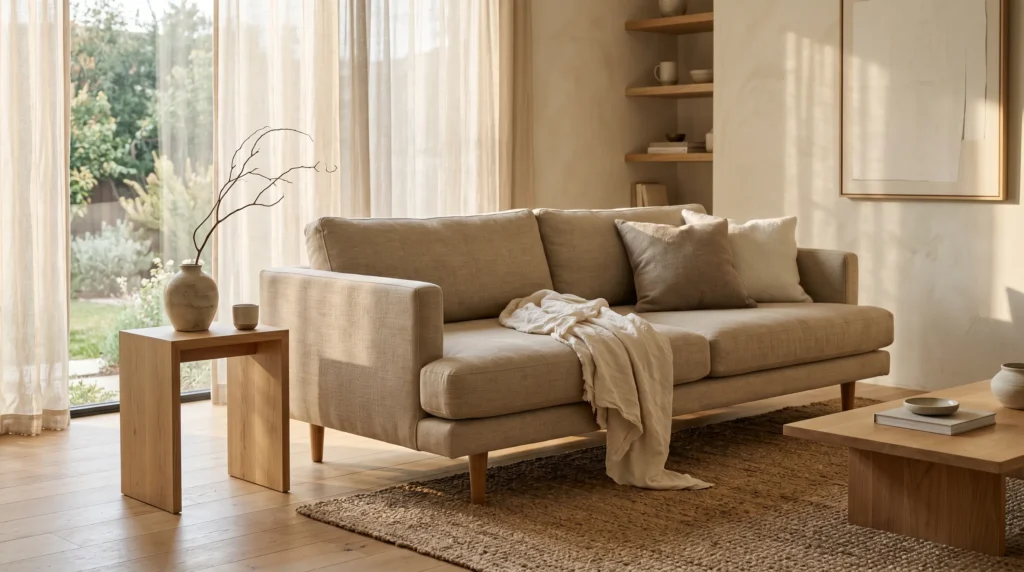
When you do add accessories, choose each one deliberately. A single well-chosen lumbar pillow in a contrasting texture — perhaps a hand-loomed cotton or a piece of vintage Japanese textile — speaks louder than a pile of matching throw pillows. A lightweight linen throw draped casually over one arm adds warmth without bulk. A small side table in natural wood or stone provides function and beauty in equal measure.
Layer Natural Textures
The Japandi palette is restrained, which means texture becomes the primary source of visual interest. Pair your linen sofa with a handwoven jute rug, raw ceramic vessels, and perhaps a paper floor lamp with warm, diffused light. Each texture should feel organic and imperfect — a counterpoint to the clean lines of the sofa itself.
Ground With Nature
A single branch of cherry blossom, a potted snake plant in a raw ceramic vessel, or a tray of smooth river stones brings a living element to the composition. Nature is never decorative in Japandi design; it is essential, a reminder of our connection to the larger world.
Our Top Japandi Sofa Picks
After extensive research and consideration of craftsmanship, materials, silhouette, and value, we have selected the following Japandi-inspired sofas that best embody the principles we have discussed. Each represents a different approach to the aesthetic, from the purist’s choice to more accessible interpretations.
[INSERT PRODUCT CARD: low-profile linen sofa in natural oak finish with Japanese-inspired clean lines and loose back cushions, 3-seater, warm beige linen upholstery]This stunning three-seater captures the essence of Japandi with its low 15-inch seat height, solid white oak base, and relaxed linen upholstery. The loose back cushions provide sink-in comfort while maintaining a structured silhouette. The natural oil finish on the oak allows the wood grain to remain visible, developing a rich patina over years of use. The warm beige linen is pre-washed for that perfectly imperfect, lived-in look from day one.
[INSERT PRODUCT CARD: minimalist Scandinavian-Japanese hybrid sofa with tapered walnut legs and tight upholstered back in sand-colored performance fabric, 84-inch width]For those who prefer a slightly more structured look, this 84-inch sofa blends Scandinavian mid-century proportions with Japanese material sensibility. The tapered walnut legs provide elegant lift, while the tight back maintains a clean line unbroken by cushion seams. The performance fabric — a linen-look polyester blend — offers practical stain resistance without sacrificing aesthetic authenticity. The sand color is that perfect raw-linen neutral that defines the Japandi palette.
[INSERT PRODUCT CARD: modular low-profile sectional sofa with solid ash wood frame and removable linen cushion covers in oatmeal color, configurable left or right chaise]Modularity meets Japandi philosophy in this configurable sectional. The solid ash frame is finished with a natural water-based sealant, and the generous, removable cushion covers make cleaning and eventual replacement effortless — an investment in longevity that aligns with both sustainability and the wabi-sabi acceptance of wear. The oatmeal-colored linen softens beautifully with washing, embracing imperfection as a design feature.
[INSERT PRODUCT CARD: Japanese tatami-inspired floor sofa with solid oak base and deep wool boucle upholstery in warm ivory, 2-seater loveseat style]For the purist, this tatami-inspired floor sofa brings the Japanese influence to the forefront. Sitting just inches from the ground on a wide oak plinth, it invites a slower, more grounded way of sitting. The deep wool boucle upholstery in warm ivory provides incredible textural depth and year-round comfort. This is a piece for meditation rooms, reading nooks, or any space where stillness is the priority.
[INSERT PRODUCT CARD: curved Japandi sofa with solid walnut legs and soft charcoal linen-blend upholstery, 3-seater with gently rounded arms]This sofa introduces a gentle curve to the Japandi vocabulary — a nod to Scandinavian organic forms that softens the overall impression without abandoning restraint. The solid walnut legs provide a warm contrast to the charcoal upholstery, and the gently rounded arms invite you to settle in. The linen-blend fabric offers the look of pure linen with added durability for busy households.
[INSERT PRODUCT CARD: handcrafted Japanese-style sofa with woven rattan back panel and natural cotton canvas cushions, exposed white oak frame]The woven rattan back panel transforms this sofa into something truly special — a piece that reads as sculpture from every angle. Designed to float in a room rather than sit against a wall, it features a hand-woven rattan back that filters light beautifully. The natural cotton canvas cushions are removable and replaceable, and the exposed white oak frame showcases traditional joinery. This is a statement piece that still whispers rather than shouts.
[INSERT PRODUCT CARD: compact apartment-sized Japandi sofa in warm greige performance velvet on light beech wood legs, 72-inch width perfect for small spaces]Not everyone has room for a sprawling sectional, and this 72-inch sofa proves that Japandi principles scale beautifully. The warm greige performance velvet offers a surprising textural twist — soft and inviting with a subtle sheen that catches light beautifully. The light beech wood legs keep the piece feeling airy, and the compact depth maintains generous seating without overwhelming smaller living rooms.
[INSERT PRODUCT CARD: convertible daybed sofa in natural linen with solid oak frame and adjustable backrest, functions as sofa and guest bed]Japanese design has long embraced multi-functionality, and this convertible daybed honors that tradition. By day, it is a sophisticated Japandi sofa with an adjustable backrest that allows for upright sitting or relaxed lounging. By night, it transforms into a comfortable guest bed. The solid oak frame and natural linen upholstery ensure it looks beautiful in either configuration — no compromise between form and function.
[INSERT PRODUCT CARD: oversized deep-seat Japandi sofa in slubby natural cotton weave with low wide arms that double as side tables, walnut base frame]For those who love to lounge, this oversized deep-seat sofa offers unparalleled comfort within a Japandi framework. The low, wide arms are designed at coffee-table height, providing a natural perch for a tea cup or book. The slubby cotton weave has a beautiful irregular texture that celebrates natural fiber, and the walnut base grounds the generous proportions with warmth and sophistication.
Frequently Asked Questions
What exactly is Japandi style?
Japandi is a design style that blends Japanese wabi-sabi aesthetics — embracing imperfection, natural materials, and simplicity — with Scandinavian hygge principles of warmth, comfort, and functional beauty. In furniture, it translates to clean-lined pieces made from natural materials in a restrained palette of warm neutrals.
Are Japandi sofas comfortable for daily use?
Absolutely. While Japandi sofas prioritize clean lines and visual restraint, they are designed for real living. The low profiles encourage relaxed posture, and the emphasis on natural materials like linen and wool creates seating that breathes and adapts to temperature. Many designs feature deep seats and plush cushions that offer exceptional comfort.
How do I keep a light-colored Japandi sofa clean?
Prevention is key — treat linen and cotton upholstery with a fabric protector before use. Vacuum weekly with an upholstery attachment, and address spills immediately by blotting (never rubbing) with a clean, damp cloth. Removable cushion covers can often be dry-cleaned or gently machine-washed. Many Japandi sofas now come in performance fabric options that resist stains while maintaining the organic look.
Can I mix Japandi with other styles?
Japandi’s restraint and neutrality make it remarkably versatile. A Japandi sofa pairs beautifully with mid-century modern side tables, vintage rugs, contemporary art, and even the occasional antique. The key is maintaining the Japandi emphasis on quality natural materials and negative space — let the sofa anchor the room, and curate other pieces with the same intentionality.
What wood tones work best with Japandi sofas?
Lighter, natural wood tones are the hallmark of Japandi design — think white oak, ash, beech, and light walnut. These finishes should feel sun-bleached and organic rather than heavily stained. Darker walnut can work beautifully as an accent, especially when paired with lighter upholstery, but avoid very dark espresso or black wood finishes that feel too heavy for the aesthetic.
Final Thoughts
Choosing a Japandi sofa is about more than selecting a piece of furniture — it is about embracing a philosophy of living. It asks us to slow down, to choose quality over quantity, to find beauty in imperfection, and to create spaces that nurture rather than overwhelm. The right Japandi sofa becomes a daily invitation to breathe, to rest, and to be present.
As you search for your perfect piece, remember the principles that define this aesthetic: low profiles that ground and open, natural materials that age with grace, colors drawn from the earth, and lines that are clean but never cold. Trust your hands as much as your eyes — the tactile experience of natural linen, solid wood, and well-made cushions is what transforms a beautiful sofa into a beloved one.
Your living room is where life unfolds. Make it a space of quiet comfort, clean lines, and honest beauty. Make it Japandi.
Related Articles
- The Warm Minimalist’s Guide to Choosing a Sofa That Feels Like Home — Learn how to balance comfort and aesthetics in your sofa search
- Velvet vs. Linen vs. Boucle: The Luxury Sofa Fabric Guide — Discover which upholstery material suits your lifestyle best
- The Curved Sofa Trend: How to Choose Organic Shapes for Your Space — Explore why curved sofas work beautifully in Japandi interiors
/